
What is OCD?
OCD causes some people to have scary thoughts, pictures or urges that get stuck in their minds (called obsessions). They find it hard to stop worrying about things like someone might get sick, hurt, or dying or things might be germy or dirty. This can feel distressing. To help relieve the scary thoughts and distressed feelings, the person can behave in a certain way (compulsions) over and over again.
Below are some videos explaining what OCD is.
King's Health Partners: OCD - anxiety, diagnosis, support and intrusive thinking Mind of the Matter
This video explains what OCD is, what the signs of OCD are and what support and treatment can help. This video is 8 minutes 39 seconds.
Mind: What is Obsessive-Compulsive disorder?
This video explains what OCD is, what obsessions and compulsions are and how to get support. This video is 1 minute 54 seconds.
Childline: OCD ft. Katie d'Ath
A video explaining what OCD is and how to cope. This video is 6 minutes 21 seconds.
Mind: Experiences of OCD and supporting young people - Lily
A video of a young person sharing their experience of OCD. This video is 1 minute 12 seconds.
OCD Action & South London and Maudsley NHS Foundation Trust: OCD Is Not Me
A video explaining OCD to parents and carers of children and young people with OCD. This video is 6 minutes 33 seconds.
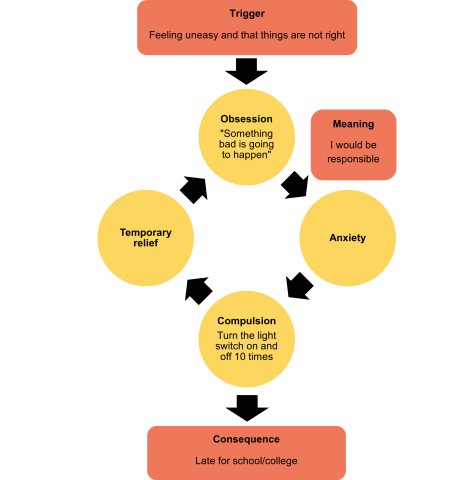
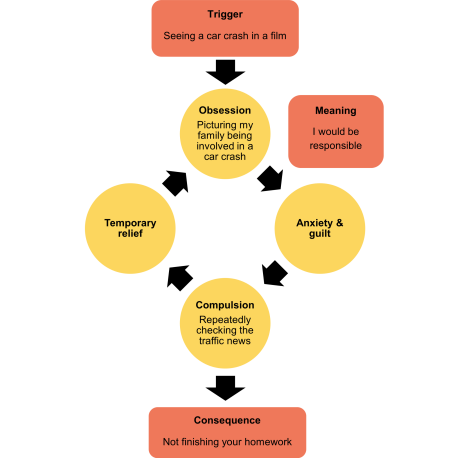
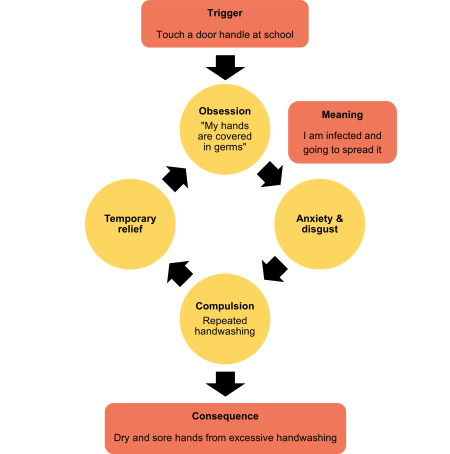
The OCD cycle
- Situation
- Obsessions
- Anxiety
- Compulsions
- Relief
Below is a video from Mind explaining the OCD cycle. This video is 29 seconds.
Everyone has unwanted, unpleasant thoughts and images pop into their minds, often around issues of harm or danger. These thoughts aren’t important, and we can’t stop ourselves from having them, but some people become worried about these thoughts, thinking they are important and might come true. When this happens, the thoughts can repeat themselves and can lead to feeling very distressed.
Some examples of OCD obsessions are below. You may experience some, all or none of these, that is okay., everyone experiences OCD differently.
- Fear of contamination such as getting ill from germs, animals or dirt
- Fear of hurting someone such as violent or aggressive thoughts
- Unwanted sexual thoughts
- Religious obsessions
- Fear of losing control
- Perfectionism
- Health-related fears
- Fear of making a mistake
- Relationship doubts
“Compulsions” are the things we do to try and stop obsessive thoughts from coming true. These are usually behaviours. Compulsions can be behaviours that other people can see like hand washing, but they can also be things we say to ourselves that other people can’t see, like counting in our head or thinking certain words.
Some examples of OCD compulsions are below. You may experience some, all or none of these, that is okay., everyone experiences OCD differently.
- Excessive handwashing
- Checking and rechecking
- Mental rituals such as counting or repeating
- Praying excessively
- Reorganising and arranging items
- Seeking repeated reassurance from someone you trust
- Frequent doctor visits
- Avoiding certain situations or objects
You may avoid certain objects, situations, places or people to avoid your obsessions and feelings of distress.
OCD cycle examples
You might experience different feelings with your OCD, this could be:
- Anxiety
- Guilt
- Disgust
- Shame
There are some examples below.
OCD and family accommodation
Family accommodation is a term to describe the changes that families, parents and carers make in their own behaviour to help their children avoid or lessen feelings of anxiety. OCD is very good at not just trapping young people, but also families, into doing what it wants. It is a really natural parental response to want to protect your child and to reduce their distress, therefore it is understandable to fall into patterns of accommodating anxiety and OCD. However, when a young person is struggling with OCD, this accommodation often works similarly to compulsions - helping to reduce distress in the short-term but keeping the OCD going in the long-term.
Remember - you are likely accommodating your child's OCD but that is a normal response, and you are not to blame. Be compassionate with yourself. However, you can play a role in overcoming OCD by becoming aware of your accommodations and making plans to change them.
Family accommodation includes participation in anxiety-driven behaviour and/or modifying family routines and schedules. Examples of participation in anxiety-driven behaviours include answering the same question over and over, buying large quantities of cleaning materials, turning light switches on and off several times etc. Active participation in these behaviours usually take up a lot of time and often causes parents frustration! Modification of family routines and schedules includes making changes to the patterns of daily life because of your child's OCD, such as no longer inviting guests over, going to work later than usual or arriving home early.
- Have a look at the Family Accommodation Scale to think about how you may be accommodating your child's OCD
- Start writing down ways that you accommodate their OCD and how often these happen
- Try to make small changes to these accommodations and be consistent
OCD and neurodivergence
We know that there is a large crossover between OCD and neurodivergence, particularly Autism Spectrum Condition (ASC), and a lot of the young people that we work with do experience both. Please see this leaflet and National Autistic Society website to learn more about the common crossovers between the two diagnoses, however, we know that it is not easy to unpick.
Using this information, it may be helpful to start to work out which repetitive behaviours are linked to OCD and which may be due to an autistic/neurodivergent need. As a parent, you can still work at reducing the unhelpful accommodation for OCD whilst also working out the helpful accommodations for neurodivergence.
We encourage you or your parents and carers to talk to your clinician about adjustments you may need. We will make adaptations to support you to engage with the treatment we offer.
Below are some example of adjustments you could ask for.
- Movement breaks during sessions
- Turning bright lights off
- Using visuals or writing your thoughts down
- Session plans sent before and after sessions
How can I help myself?
If you have to wait for therapy or you can't access it for any reason, or if you just want to try things to help yourself here are some things you can do to manage anxiety.
- Talk to someone you trust about how you are feeling - you could use an emotion wheel and body map to help you identify and explain your feelings.
- Moving – walking, running or doing any form of exercise - especially if it is outside, you could listen to music or a podcast at the same time.
- Breathing – taking control of/slowing down your breathing can help you feel calmer. Try taking a slow deep breath in through your nose for 5 seconds, hold this breathe for 5 seconds, then slowly breathe out through your mouth for 5 seconds. You may find the West Sussex Mind video below helpful.
- Personal Coping Plan - you might find it helpful to do this with someone you trust, there is more information on this here.
- Self-soothe box - you might it helpful to make this, there is more information on this here.
- Distraction and grounding techniques - you might like to use the 5-4-3-2-1 technique. Name 5 things you can see, 4 things you can feel, 3 things you can hear, 2 things you can smell and 1 thing you can taste
- Relaxation and mindfulness - you can find guided relaxation and mindfulness videos on YouTube or there are some apps below.
Mind: 30 second breathing exercise
This video guides you through a short breathing exercise. The video is 31 seconds.
How can I support my child?
Talking them about their OCD cycle and support them to use strategies in the 'How Can I Help Myself' section.
You can also start to think about how you reduce how much you are accommodating your child's OCD. More information on this is above in the section 'OCD and family accommodation'.
Below is a video from Mind about how to support someone with OCD. This video is 2 minutes.
Support while I am waiting
We know that it can be difficult waiting for therapy to start.
There are a number of different places that can offer some support whilst you wait, and there are places that you can go to learn more about OCD. Some of these support services and resources are outlined below.
Please note that none of these support services are a replacement for treatment, but they can be a good way to connect with others with common experiences and continue working towards your goals. They are also may not be able to provide urgent help.
If your life is in immediate danger, please call 999 or go to A&E.
- Text the word SUSSEX to 85258 (free NHS 24/7 mental health text-messaging support service)
- Call NHS 111 and select the mental health option (free 24/7 advice service for anyone concerned about their own, or someone else’s, mental health)
- Call Samaritans on 116 123 (free 24/7 listening service providing support and advice for anyone having thoughts of suicide). You can also email: jo@samaritans.org
- Call Hopeline247 on 0800 068 4141 (free 24/7 listening service offering support and advice for young people having thoughts of suicide). You can also email: pat@papyrus-uk.org or text: 88247
- Call Childline on 0800 1111 (free 24/7 support and advice for young people who want to talk about how they are feeling). You can also speak to a trained professional via web chat: https://
www. childline.org.uk/ get-support/ 1-2-1-counsellor-chat/
If you do not current have a lead practitioner within CAMHS and you are waiting for treatment, you can contact the CAMHS duty team if your mental health gets worse and you need some support. The duty team is not an emergency service, and you can expect to get a response within 2 to 14 working days, if you require more urgent help, you should call 111/999/attend A&E.
OCD Action support groups
OCD Action offer a range of support groups providing a safe and welcoming environment where you can connect with others with similar experiences and offer mutual support without judgement. All support groups are peer led and facilitated by a dedicated team of trained volunteers.
For young people aged 16-20, with OCD/BDD/Trich & Derm: First and third Thursday of the month, 7pm via Zoom
For parents/guardians of people of any age with OCD - Third Wednesday of the month, 7pm via phone
For parents/guardians of people of any age with BDD - First Tuesday of the month, 7pm via Zoom
For parents/guardians of children (aged 17 and under) with OCD - First Thursday of the month, 7pm via Zoom
To join a support group, go to https://ocdaction.org.uk/online-support-groups/
For anyone who would like more information before they sign up please email sign-up@ebtsupportgroups.co.uk or call 020 7253 5272.
OCD Action youth e-helpline
Complete form on https://
The Youth e-Helpline is for anyone between the ages of 14 and 25 who is affected by OCD or a related condition (such as BDD or a Body-focused Repetitive Behaviour). Whether you live with OCD yourself, or are concerned about a friend or family member, Youth e-Helpline volunteers are here to support you!
You don’t need to have a diagnosis of OCD to get in touch. In fact, about half of the young people who email are unsure about whether they have OCD or not. The Youth e-Helpline team is made up of volunteers who are mostly young people with OCD themselves, so they really understand the challenges of living with OCD when you’re young. They can chat to you about how you’re feeling and offer you support and information about OCD and how to access the recommended treatments. OCD can be exhausting and isolating, but it really can get better!
OCD UK support groups
OCD UK also provide a range of online support groups. Whilst these are primarily for those aged 18+, they do offer 'themed' support groups, often including one for young people aged 12-17 and one for families and friends. These are held via Zoom.
You can check upcoming groups and their dates, and sign up, on their website - https://
OCD UK Parent Project
OCD UK has been granted some funding from the National Lottery Community Fund to design and deliver online and in-person educational workshops for parents who have children with OCD. The project is specifically designed for parents who have children between the ages of 5-18 which is the CAMHS age bracket. Workshops cover an introduction to OCD, symptoms, evidence-based treatment, how to help at home, parent interaction and lived experience.
Book a place here - https://
For any questions about the project, email parents@ocduk.org
More information about OCD
Below are some links to additional information about OCD.
Please note: This is a collection of resources that children and young people often find helpful, and they are not authored by or owned by Sussex Partnership NHS Foundation Trust. We will attempt to keep these resources as up to date as possible, but you may find changes with the links and information given.
Websites
This website link explains what OCD is, the causes and symptoms of OCD and ways to look after yourself.
This website link has resources to explain what OCD is, treatment for OCD and support you can access.
This website link has information about what OCD is and treatment for OCD.
This website links includes a link to getting support for OCD and phobias from this organisation.
OCD UK - guide for young people
Please see this guide from OCD UK about what OCD is, types of OCD, treatment for OCD and answers to common questions you may have.
Webinars
OCD Action and OCD UK has a series of webinars on various topics such as understanding compulsions, information about treatment and personal stories.
YoungMinds - supporting your child or young person
The link below describes what OCD is, how to identify OCD in your young person and what you can do to help them.
Obsessive-Compulsive Disorder (OCD) | Parent Guide | YoungMinds
Anna Freud - Supporting Children and Young People
The links below provide information on supporting children and young people with OCD. They give an overview of the OCD, signs to look out for and how to support them.
Supporting children and young people with obsessive compulsive disorder (OCD) | Anna Freud
OCD UK - Guide for parents and carers of children and young people with OCD
Please see this guide from OCD UK about what OCD is, treatment for OCD and answers to common questions you may have.
Webinars for parents and carers about supporting children and young people with anxiety
Sussex Partnership NHS Foundation Trust - OCD: A parent and carer workshop
This webinar is 1 hour and 43 minutes, it provides more detailed information about anxiety, specific issues for children and young people and how can you help as a parent or carer.
West Sussex Mind - OCD & Intrusive Thoughts
This webinar is 25 minutes, it provides more detailed information about OCD, symptoms of OCD, why OCD happens and how can you help as a parent or carer.
OCD Action & OCD UK
OCD Action and OCD UK has a series of webinars on various topics such as understanding compulsions, information about treatment and personal stories.
Please note some of these app may require payment or paid subscriptions to access certain features of the apps.
For OCD

What's Up? is a free app utilising some CBT (Cognitive Behavioural Therapy) and ACT (Acceptance Commitment Therapy) methods to help you cope with Depression, Anxiety, Anger, Stress and more!
Features include:
- Strategies to help with immediate distress management
- Advice on identifying unhelpful thinking patterns and challenging them, understanding your thoughts better and managing worries
- Information on anger, anxiety, depression, self-esteem and stress
- Diary feature
- Habit tracker
- Notes

MindShift aims to help you learn how to relax, develop more helpful ways of thinking, and identify active steps that will help your anxiety. This app includes strategies to deal with everyday anxiety as well as specific tools to tackle: Test Anxiety, Perfectionism, Social Anxiety, Performance Anxiety, Worry, Panic, Conflict.

The Virtual Hope Box is an app that contains simple tools to help with coping, relaxation, distraction and positive thinking. The content can be personalised based on your specific needs.
Features include:
- Distract me - sudoku puzzles, photo puzzles, word searches and mahjong solitaire
- Inspire me - inspiring quotes that can be fully personalised and added to with your own
- Relax me - controlled breathing, muscle relaxation and guided meditations
- Coping tools - create your own personalised coping cards to remind you of coping strategies you find helpful
For parents and carers

Combined Minds helps families and friends to find ways to provide the right environment to help the individuals they support affect their own change. This provides support to families and friends to help them understand and manage their loved one's difficulties including anxiety, depression, self-harm, eating disorders, digital addiction and safety planning.
For mindfulness and relaxation

Free mobile app with virtual “bells” to time and support your meditations, and access to lots of guided meditations by many different meditation teachers.

Chill Panda is a game-style app that incorporates breathing exercises and coping strategies to help manage anxiety in an interactive way. You can engage in the app by playing the full game mode or use the "Quick Chill" function to access skills quickly.
You may find other helpful apps on the Sussex Health and Wellbeing app library.
Please note that not all of these books may be available to loan at your local library.
Books for younger children

Ideal for children aged 5 to 12 years old
A book that explores what OCD is, how obsessions and compulsion impact young people and how people can support through the life of Katie, a teenager with OCD.

Ideal for children aged 6 to 12 years old
This book helps children to understand and manage their OCD using Cognitive Behavioural Therapy techniques through activities such as stories, drawing and games.

Ideal for children aged 7 to 11 years old
This book explores the experience of OCD through a boy called Felix.
Books for older children and teenagers

Ideal for children aged 12 years and above
A book that explores how OCD through the lives of David, Riya and Sarah.

Ideal for children aged 10 years and above
A book that uses Cognitive Behavioural Therapy techniques to help young people understand their OCD and provides strategies to manage their OCD.

Ideal for young people aged 10 years and above
A book about Joe Wells sharing his experience of OCD, the coping strategies he learnt and treatment that worked for him.
Books for parents & carers

This book helps parents and carers to understand the causes of their child's anxiety and OCD and offers practical strategies to support them such as addressing family accommodation.

This book shares the experience of Claire managing her son's severe OCD. She talks about diagnosis, treatment and shares practical strategies for how to cope as a parent.

This book shares the experiences of parents and carers whose children have mental health difficulties. It helps parents and carers to understand their child or young person's difficulties, how you can support them and shares practical strategies for how to cope as a parent.